 Add to Chrome
 Add to Firefox
 Add to Edge
Insight Agents: An LLM-Based Multi-Agent System for Data Insights
Jan 27, 2026
Today, E-commerce sellers face several key challenges, including difficulties in discovering and effectively utilizing available programs and tools, and struggling to understand and utilize rich data from various tools. We therefore aim to develop Insight Agents (IA), a conversational multi-agent Data Insight system, to provide E-commerce sellers with personalized data and business insights through automated information retrieval. Our hypothesis is that IA will serve as a force multiplier for sellers, thereby driving incremental seller adoption by reducing the effort required and increase speed at which sellers make good business decisions. In this paper, we introduce this novel LLM-backed end-to-end agentic system built on a plan-and-execute paradigm and designed for comprehensive coverage, high accuracy, and low latency. It features a hierarchical multi-agent structure, consisting of manager agent and two worker agents: data presentation and insight generation, for efficient information retrieval and problem-solving. We design a simple yet effective ML solution for manager agent that combines Out-of-Domain (OOD) detection using a lightweight encoder-decoder model and agent routing through a BERT-based classifier, optimizing both accuracy and latency. Within the two worker agents, a strategic planning is designed for API-based data model that breaks down queries into granular components to generate more accurate responses, and domain knowledge is dynamically injected to to enhance the insight generator. IA has been launched for Amazon sellers in US, which has achieved high accuracy of 90% based on human evaluation, with latency of P90 below 15s.

Explainable AI using expressive Boolean formulas
Jun 06, 2023


We propose and implement an interpretable machine learning classification model for Explainable AI (XAI) based on expressive Boolean formulas. Potential applications include credit scoring and diagnosis of medical conditions. The Boolean formula defines a rule with tunable complexity (or interpretability), according to which input data are classified. Such a formula can include any operator that can be applied to one or more Boolean variables, thus providing higher expressivity compared to more rigid rule-based and tree-based approaches. The classifier is trained using native local optimization techniques, efficiently searching the space of feasible formulas. Shallow rules can be determined by fast Integer Linear Programming (ILP) or Quadratic Unconstrained Binary Optimization (QUBO) solvers, potentially powered by special purpose hardware or quantum devices. We combine the expressivity and efficiency of the native local optimizer with the fast operation of these devices by executing non-local moves that optimize over subtrees of the full Boolean formula. We provide extensive numerical benchmarking results featuring several baselines on well-known public datasets. Based on the results, we find that the native local rule classifier is generally competitive with the other classifiers. The addition of non-local moves achieves similar results with fewer iterations, and therefore using specialized or quantum hardware could lead to a speedup by fast proposal of non-local moves.
Graph Coloring with Physics-Inspired Graph Neural Networks
Feb 03, 2022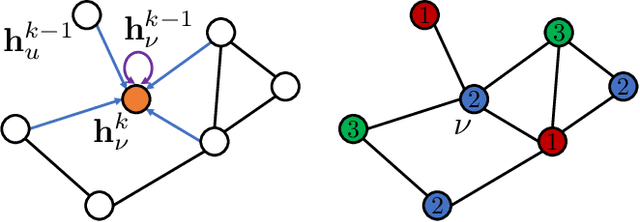
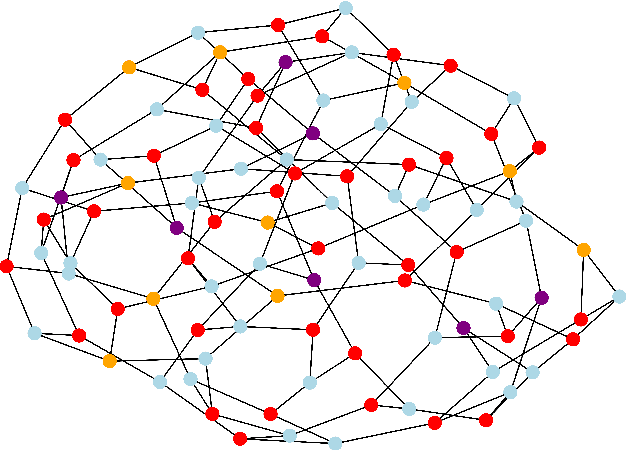
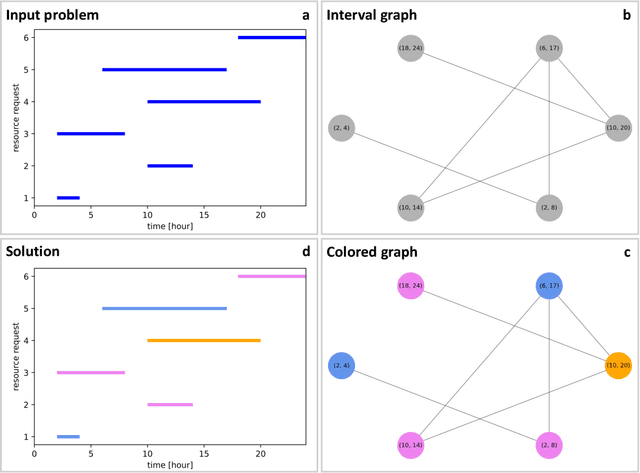
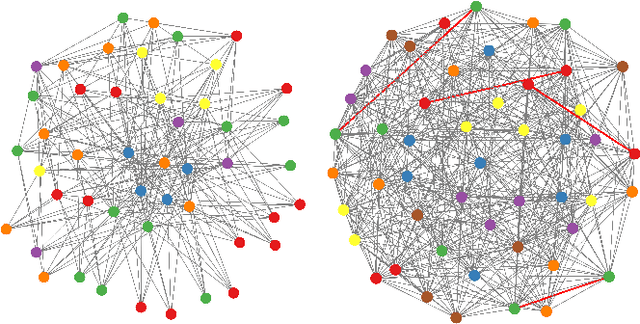
We show how graph neural networks can be used to solve the canonical graph coloring problem. We frame graph coloring as a multi-class node classification problem and utilize an unsupervised training strategy based on the statistical physics Potts model. Generalizations to other multi-class problems such as community detection, data clustering, and the minimum clique cover problem are straightforward. We provide numerical benchmark results and illustrate our approach with an end-to-end application for a real-world scheduling use case within a comprehensive encode-process-decode framework. Our optimization approach performs on par or outperforms existing solvers, with the ability to scale to problems with millions of variables.